Downtown Traffic Study Survey
Weigh in on mobility in downtown Wake Forest by participating in the survey below.
 Overview
The adopted 2019 Town of Wake Forest Comprehensive Transportation Plan (CTP) contains a number of action items aimed at improving street connectivity, public transportation, safety, and bike/pedestrian infrastructure.
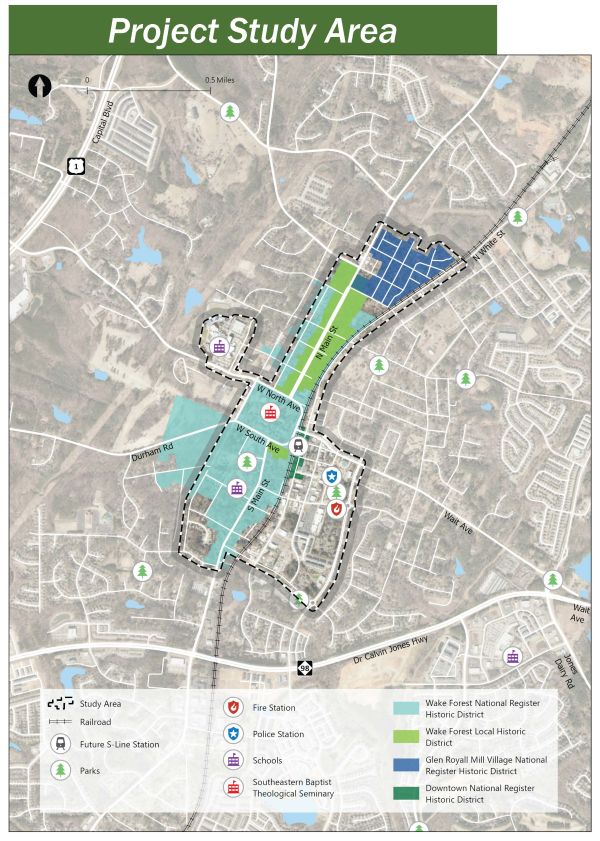
One significant action item from the CTP was to study and recommend policies that would improve Downtown mobility for drivers, cyclists, and pedestrians, with specific emphasis on the area around the Southeastern Baptist Theological Seminary.
Due to the future redevelopment and infrastructure activity planned for Downtown, including the S-Line rail corridor project, the Wake Forest Board of Commissioners authorized the study to commence in 2026.
The Downtown Traffic Study will serve as a project focused on the Downtown Area in Wake Forest that carefully analyzes challenges associated with traffic volumes, roadway capacity, maintaining historic character, key intersection functionality, and upcoming changes resulting from the S-Line rail corridor project, including the addition of a Downtown Mobility Hub, road closures, and planned grade separations.
 Engagement Updates
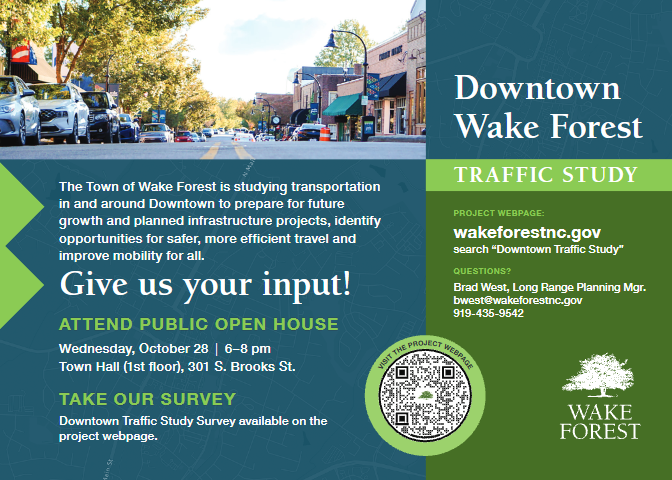
The Downtown Traffic Study will periodically offer engagement opportunities for both residents and business owners of Wake Forest. Stay tuned for announcements regarding these opportunities!
Weigh in on mobility in downtown Wake Forest by participating in the survey below.
The congestion feels unsafe at times. It requires aggressive acceleration and heavy braking because of how it’s layed out. A lot of people now dislike wake forest and want to move. This is sad to me as I used to be proud of my town. I don’t really want to live here anymore.
Margaret.
Way, way back when before international building codes, zoning, and UDOs, there was a guy or a lady who just built something, and if he or she didn't want to have a sidewalk, it wasn't built until their kids complained they didn't have a place to roller skate or skateboard, or the parents got new carpet and decided a sidewalk was something worth having so not to track in clay. (The latter is why my family decided it was time for one.)
Less way back, people complained and the People decided we needed to make People care. So we had our cities or towns manage it; they added all sorts of additional things, like sidewalks, but all these regulatory costs added inflation to the cost of house, but now our houses had "safety" and "uniformity" and "equity". Some great items resulted: like having outlets every so often, and deciding that stairs should uniform in step and run. Back to sidewalks, in the places I grew up in the 70s through 90s, in Raleigh, Charlotte, Pineville, Matthews, the cities required the developers to put them in, but the "uniformity" and "equity" were not to par. So then they decided to levy a tax/fee for cost of those sidewalks, and the city or town would complete them uniformly. Unfortunately, the cities had other priorities so they never got done. And by the time they would get around to it decades later they found those fees that complete paid for the sidewalks, now could only pay for 1/3 or 1/2 of the sidewalks and the taxpayers had to pay for the sidewalks again, and again, and again (buying houses from those developers, and taxes multiple times). Then when I was in college, we got ADA sidewalks and the new cool ramps, so towns spent money ripping up sidewalks ends and putting in ramps. We don't have many people using them that are truly ADA in comparison to the sidewalk traffic, but we all got to benefit with our strollers, our bikes, and anything else with wheels! That was great! Unfortunately, redoing those sidewalk ends every 5 to 10 years because the ramps need bumps, or less slope, or whatever, takes away money from ever doing those other sidewalks that in 50 to 70 years, just never got done.
When we moved onto S. Main St. in 2003, and the bypass was still coming, we were told that the semis and trucks would be prohibited except for "local traffic only". The traffic would be a small fraction in the near future. The bypass, not having any lights and at highway speeds would be the preferred and natural draw for traffic.
The development on the bypass is such a disaster that instead of going along the bypass and through all those lights and congestion to S. Main, we snake down business 98 at the Food Lion instead and go through all of downtowns "small" major roads. Everyone bypassing the bypass contributes to the problem, because of poor execution of developments along the bypass and US 1 corridor. It was originally designed, planned well. How this area has been developed messed it up. There used to be a service road back when parts of US 1 were still 2 lanes (1 each direction). Yes, I lived south of here at the time off Perry Creek Road. You can still see a small remnant of that service road near 98 business and McDonalds with a small abandoned business that used to be on the service road.
It was a plan that should have worked, but because the plan was ignored and bypass is a joke. We now have this mess.
I don't know if making the seminary a one way loop will help. Since we often bypass South Av and E Roosevelt congestion by using Wingate, this will force all the traffic into that one path instead of splitting it. If the round-a-bouts are removed and stops are added it will work to slow everyone down. But I think it will slow everything down to a stop, and cause a gridlock, and increase rear-end accidents and cause even more issues with students. It reminds me when Raleigh first did this back in the late 80s. It wasn't until they synched all the lights, that at least N-S things were moving again - but then everyone was going 45mph down streets that were 35 mph and still dangerous. The roundabouts we have slow down traffic w/o causing them to stop, it also means people don't have time to sit on their phones while they are driving as much, and less chance they will kill someone. Keep the roundabouts, make them 2 lanes wide if necessary. I've used the 2 lane ones in other cities and countries and they work very well to both keep traffic going and slowing it down at the same time.
S. Main Street (just south of SEBTS) is in desperate need of traffic calming. The 35 MPH speed limit is already too high for a street that is exclusively residential with an elementary school and a playground, but thru traffic regularly exceeds that due to road width. Even worse, during the summer we watch kids and parents trying to cross the street to get to the park or pool at the corner of S. Main and W. Owen. There's no crosswalk there, but pedestrians seem to feel safer crossing there then at the South Ave roundabout and I can't disagree. I regularly have near-miss crossing at the circle because drivers are looking out for cars and not people. IMO the street width should be reduced with stop signs, curb extensions and a new crosswalk at W. Owen while the speed limit should be reduced to 25. Traffic congestion is not the problem; this thru traffic should stay on the bypass rather than using residential roads to try and beat traffic. Every possible measure should be leveraged to discourage the use of South Main for thru traffic.
The traffic is already a problem so closing multiple streets is going to back up traffic even more. I don’t know the solution but we really need more lanes so streets like Main Street around the seminary don’t get so backed up
Bike lanes are fine, but there are exponentially more vehicles than bikes on these roads since our population has exploded. Lowering the speed limit to 25 mph will make the traffic even more congested than it already is, especially on Main St.. Please don’t add to the congestion!
There need to be clearly marked pedestrian crossings at the “T” where North Main St meets North Ave. While that intersection is one of the busiest, there are no traffic lights and only one sign on N Ave that suggests awareness of pedestrians. It is a no-brainer to implement well-marked pedestrian crosses from N Main to the seminary campus. Also where N College runs into the seminary. Students park their cars on N College and have to dodge traffic to cross over N Ave where steps lead to the campus. Another location that needs a crossing is at the intersection of N Wingate and Durham Rd/98 so that pedestrians can cross from one sidewalk corner to the other running North and South. Lastly, why is there no sidewalk on W Pine from N Main to WF High School?
I agree with the previous comment - bike lanes in more areas would be great.
One case in point would be connecting the greenway from the back of Heritage High School to the Neuse River Greenway south of Burlington Mill Rd
As both a student and employee at Southeastern Baptist Theological Seminary, I’m deeply concerned about the dangerous traffic on W South Ave. Cars constantly speed down this road, making it really stressful and unsafe to cross the street or parallel park during peak hours. I’ve almost been rear-ended twice now just parallel parking because drivers behind me are tailgating or paying no attention.
Give us more Bike Lanes!!!!!
More bike lanes
The morning student drop off and afternoon student pick up operations at the elementary school on S Main St causes daily traffic backup on S Main and West Vernon. These surges in traffic and resulting impatient driving result in dangerous situations.
The 35 MPH limit in South Main St is excessive. The 100 to 700 blocks of S Main are RESIDENTIAL and narrow. Further, the only crosswalk is at Elm St causing pedestrians to cross elsewhere unprotected.
As someone who often bikes in downtown Wake Forest I appreciate that the streets are able to be navigated pretty safely by bike. That being said I would appreciate lower speed limits on some roads in the downtown Wake Forest area (I believe they should all be 25 at least in the area of study highlighted here. We are in real need of protected bike lanes in town. It would be on North Main, North Ave, and Stadium drive. There is already enough space there to include them, especially on North Main which connects to Joyner park. I really enjoy the Wake Forest Go micromobility solution introduced in the past couple of years. I wish the cars would come with a bike rack for even better connectivity. Finally, I support the S-line and the mobility hub/station. I hope that there will be bike racks or bike storage included as part of the project.
| Phone | 919-435-9542 |
| bwest@wakeforestnc.gov |
Thank you for your contribution!
Help us reach out to more people in the community
Share this with family and friends